
The Jasons, like most of the families in Bayou Chicot and the surrounding area, were farmers, and each of the Jasons had a brood of children, ensuring their family’s presence in future generations. That’s how I was going to start part two of my Jason’s blog post. However, with my recent big find, that part of the story will have to wait!
I started doing family research hoping to learn more information about my ancestors, including finding out who held my ancestors as slaves. For several years now, I’ve been visiting the archives in both Opelousas and Ville Platte. Opelousas is the parish seat for Saint Landry, whereas Ville Platte is the seat for Evangeline Parish. Established in 1805 and, once, much larger Saint Landry Parish has since been carved up, forming separate parishes, including Evangeline Parish, which was established in 1901.
I remember how nervous I was going into the Opelousas archives for the first time. It was daunting, seemingly insurmountable. I was doing something that was important for my family, something that my ancestors were pushing me to do, but I didn’t even know where to start. And, I was alone. So, I took that step in. There were hundreds upon hundreds of huge books that weighed easily 25+ pounds spread across the room. No one offered to help me. No one pointed me to the starting place. I didn’t even know that I could do a search on the computer that was in the archive room. There were just these books, walls and walls of big books. Saw sections labeled marriage records, probate and succession records, notarial records’, conveyances, miscellaneous records. I ventured into reading one of the succession records – everything was in French. Okay, this is not going to work, I said to myself. I have to get some information. I took a deep breath and that’s when I decided just to start with the marriage licenses and see if I can pull licenses for the people I did know. I just started looking up surnames, and if I recognized a given name I would get a copy of the marriage license. Simple as that.
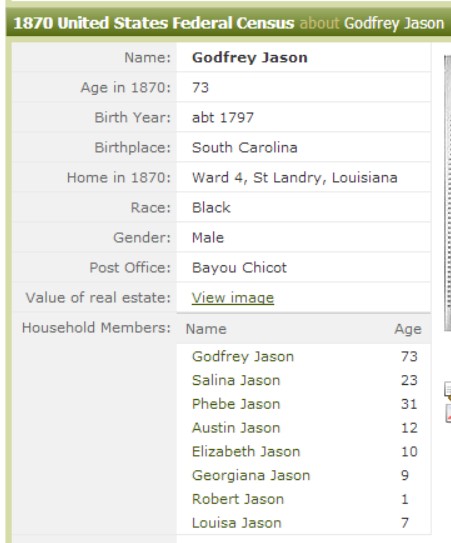
In discussing family ancestry with others, it has been my Jason family members who have had the most interest, and it’s with the Jasons that I also have the most passionate fellow family researchers. One of my researcher-cousins, Patricia, connected me to Moses Jason’s sister Hannah and their father Godfrey Jason. Patricia is a descendant of Hannah and she made me aware of the 1870 and 1880 census, which showed Moses and Hannah living as next-door neighbors.
Through the years, they were proud and close knit family, often living in clan clusters a rocks-throw from one another. That’s a tradition that’s persisted. When my family moved from Louisiana to California in the 1970s, for the first year, we lived with my uncle near the San Francisco Bay. The next year, we moved—right next door to my mother’s first cousin. Researching enslaved persons can be challenging – one reason being the propensity of slavery to split families and possibly sell family members to unknown or faraway plantations. Another reason is that ‘slaves’ had no surnames, so when do typical genealogy research you’re looking at both the given name and the surname. So if you don’t know the name of the slave ‘owner’ it can be difficult to find your ancestors under slavery.
Per the 1870 census, Godfrey Jason was born in South Carolina and this same researcher-cousin surmised that Godfrey Jason may be one and the same as ‘Old Uncle Godfrey’ mentioned in the book Old Families and Tales of Chicot; or Miss Emma’s Memoirs , where Godfrey is noted as a slave owned by the Griffith family. Using the censuses, I was able to find Moses’s and Hannah’s other likely siblings: Winifred, Phoebe, and Temperance, also known as Tempy. In this family, as in other enslaved families, it was common to name children after their grandparents and their parents siblings. This was used as a code. It helped implicitly connect families, even if they were sold and separated. Moses named two of his daughters, Winifred and Hannah; Winifred named one daughter Temperance; two of Tempy’s children were named after her sisters Phoebe and Winifred; Godfrey Tatman, found in the 1900 census, is potentially Hannah’s son—named him after her father, Old Uncle Godfrey Jason.
Three or four years after my researcher-cousin first mentioned Hannah to me, I pored through census records to find links to her brother, my direct ancestor. In 1900 and 1910, Moses Jason who was living in the same household with Tempy and her family. Then, I had no idea who Tempy was. In 1900, Tempy and Moses are living in the household of a John Brown and his wife Harriet. Tempy is listed as John’s mother-in-law, making her Harriet’s mother. Moses is listed as John’s brother, which I thought was a mistake. I wasn’t able to pinpoint the relationship between John and Moses until the 1910 census. On this census, Tempy King is listed as the head of household, living with several people, including her brother, Moses Jason. King was probably Harriet’s last name, too, I thought.


Using Rev. Donald J. Hebert’s Southwest Louisiana Records (SWLA) CD, a couple of significant marriage references, I found out a couple of things:
- Temperance Jason [Jacena] married Warren King on April 2, 1870
- Harriet King married John Brown March 30, 1891.
The Louisiana Death records on FamilySearch shows that Tempy passed on March 29, 1921, had a deceased spouse named Warren King… and that her father was Godfrey Jason! Unfortunately, no mother is listed.
Familysearch.org Louisiana Death Index entry for Tempy:

I traveled with my cousin Geraldine to the Opelousas court house, doing computer index searches and surveying marriage licenses. Then, I decided I wanted to look up sale records. MY ancestors were bought and sold. There may be a record of it. I remembered what Patricia said, about Old Uncle Godfrey and the Griffith family. So, we looked up in the vendor/vendee index several of the conveyance records for Griffiths slave transactions. Two of these references broke down the slavery brickwall.
Per the conveyance document recorded December 17, 1833, Daniel Ferguson received nine hundred dollars from Isaac Griffith in exchange for a negro male slave, age 36. The slave’s name was Godfrey. My great-great-great-grandfather!

My excitement continued when I found, in another document dated April 18, 1848. Marie Ann Ferguson [Furguson], wife of Isaac Griffith, is transferring ownership of several slaves to her daughter Hester Griffith, wife of C. D. Tatman. These slaves were a negro male named Warren, 28; a negro woman named Tempy, 23; children Bob, 6, Henry, 4; Louis, 2; and Rachel, infant. The children are listed as only Tempy’s children, but Warren may indeed be the father. Not only had a found a daughter of Godfrey, but it so happened to be the one daughter where I had proof per the death certificate that Godfrey was her father.
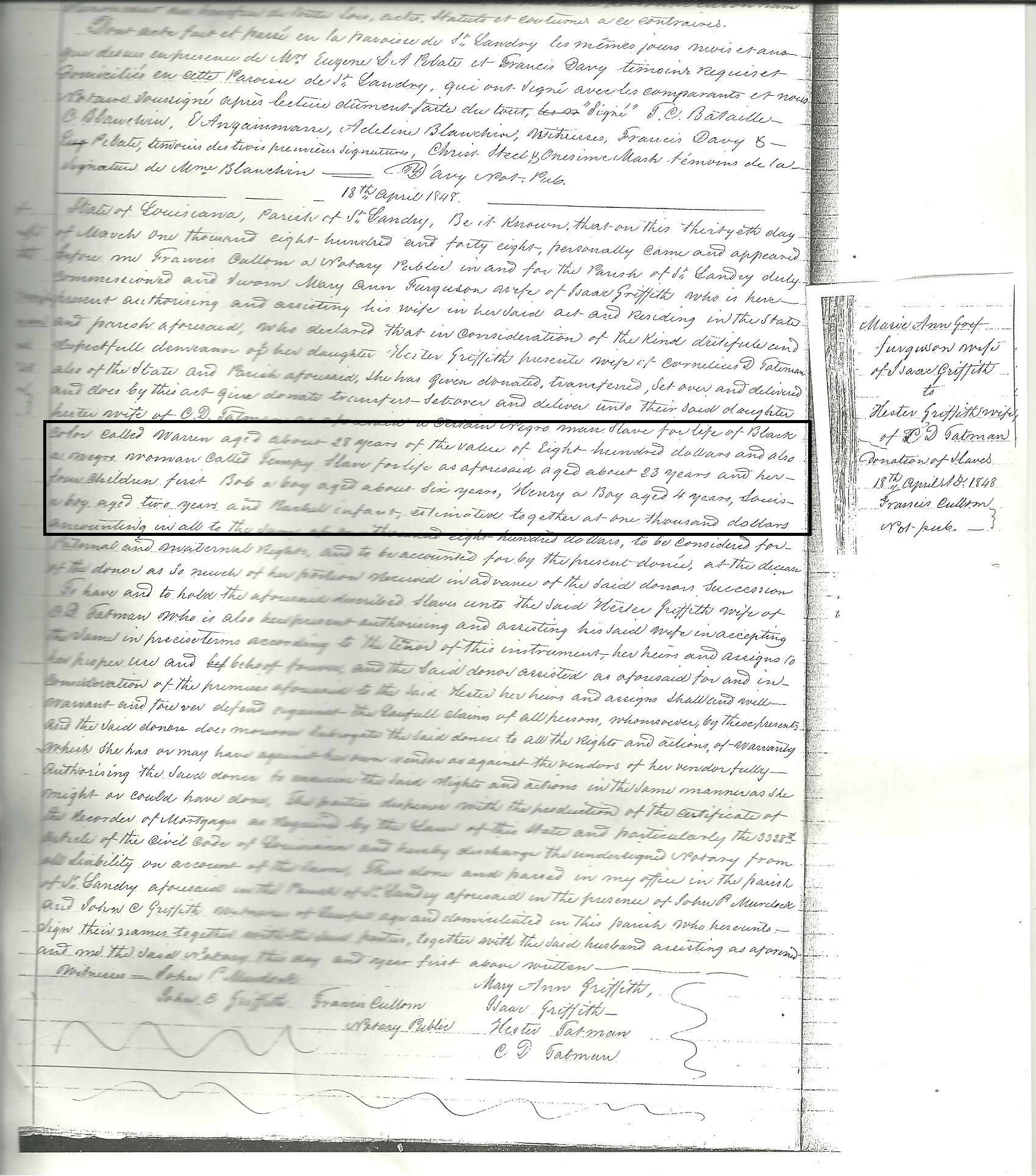
I did not have Bob, Henry, Davis, nor Rachel in my tree, prior to finding Godfrey and Tempy in the slave records. However, on the 1870 census in the domicile right next to Warren and Tempy, we find Henry [one of the children on the Tempy slave document] and his wife, Isabella, living with several of Henry’s siblings—including Harriett!

Daniel Ferguson, born in South Carolina in 1774, was the fifth son of Moses Ferguson and Elizabeth Lively. In South Carolina, Daniel married Esther (Hester) Peak(e), where five of their eight children were born; the remaining being born in Bayou Chicot. Their daughter, Mary (Marie) Anne Ferguson, married Isaac Griffith in 1815 and their daughter, Hester, married Cornelius D. Tatman in 1842. More than likely, The Ferguson, Griffith, and Tatman family records may hold additional documentation on my enslaved family members. Information obtained using this link: http://dna.cfsna.net/GEN/USA/SC/Moses_Ferguson_and_Elizabeth_Lively.html. Here are a couple of entries on the family from Rev. Donald J. Hebert’s Southwest Louisiana Records entries:
- CLARK, Elisabeth – native of this parish (major daughter of dec. John & Marie STEVENS) m. 13 July 1830 Daniel FERGUSON – native of South Carolina (major son of Moses & Elisabeth LIVELY) Wits: Francis D. SMITH, James MORGAN, Uriah FERGUSON, Edward FAHEY. Fr. Flavius Henri ROSSI (Opel.Ch.: v.1-B, p.558-B)
- GRIFFITH, Hester m. 15 Dec. 1842 Cornelius D. TATMAN (Opel. Ct. Hse.: Mar. #5) W
With these findings, I expect that it will lead me to find other enslaved relatives. Recently, I’ve been in contact with a number of DNA cousins that have known ancestors only in South Carolina and are not aware of any connections of ancestors in Louisiana. Wouldn’t it be great if I would be I able to trace my Louisiana family to our long ago- separated South Carolina family members, once again uniting them? That’s a wonderful dream…and, dreams do come true.
Happy searching!


 Ancestral Pathways LLC
You must be logged in to post a comment.